> ## Documentation Index
> Fetch the complete documentation index at: https://www.truefoundry.com/llms.txt
> Use this file to discover all available pages before exploring further.
# Register an AWS Bedrock AgentCore MCP Server
> Connect an Amazon Bedrock AgentCore runtime as a remote MCP server using AWS SigV4 authentication.
Amazon Bedrock AgentCore runtimes expose an MCP endpoint that requires **AWS Signature Version 4 (SigV4)** on every request. TrueFoundry stores shared AWS credentials on the MCP server and signs upstream calls in the MCP Gateway — users do **not** complete a Connect / OAuth consent flow.
This guide covers registering an existing AgentCore runtime that uses **IAM inbound auth**. Choose one credential type: **AWS Access Key** or **AWS Assumed Role**.
## Guide to registering an AgentCore MCP server
1. Sign in to the AWS Console in the region where your runtime lives (for example **US East (N. Virginia) / `us-east-1`**).
2. Open **Amazon Bedrock → AgentCore → Build → Runtime**.
3. In **Runtime resources**, click the runtime you want to connect (for example an IAM-backed MCP runtime such as `tfy_mcp_iam` or `tfy_test_mcp_server`). Status should be **Ready**.
 Use **Build → Runtime**, not **Discover → Registry**. The MCP invoke URL is built from the **Runtime ARN** (`…:runtime/…`), not a registry ARN.
1. On the runtime detail page, copy the **Runtime ARN**.
Use **Build → Runtime**, not **Discover → Registry**. The MCP invoke URL is built from the **Runtime ARN** (`…:runtime/…`), not a registry ARN.
1. On the runtime detail page, copy the **Runtime ARN**.
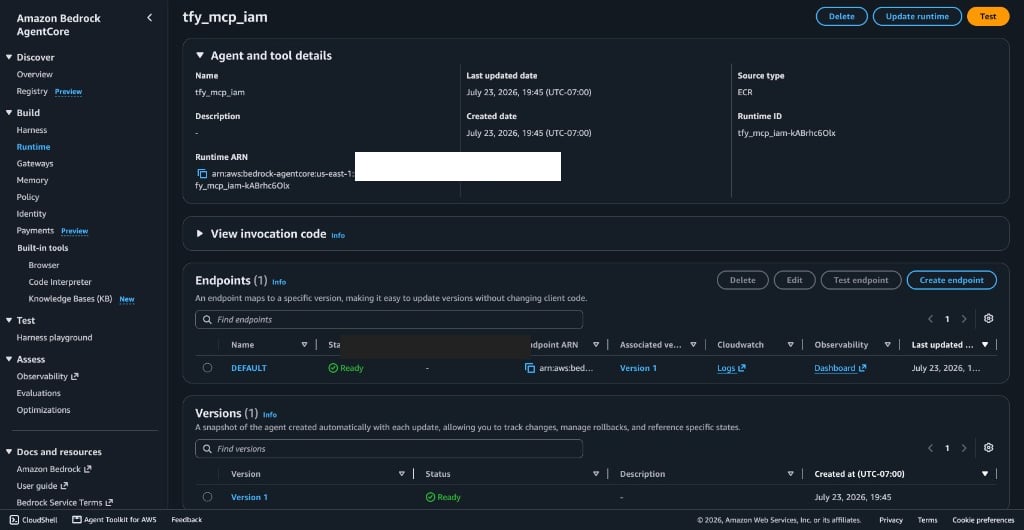 Example ARN:
```text theme={"dark"}
arn:aws:bedrock-agentcore:us-east-1:123456789012:runtime/my-runtime-abc123
```
2. Build the MCP URL with this template:
```text theme={"dark"}
https://bedrock-agentcore.{region}.amazonaws.com/runtimes/{urlencoded-runtime-ARN}/invocations?qualifier=DEFAULT
```
The ARN must be **percent-encoded** in the path (`:` → `%3A`, `/` → `%2F`). TrueFoundry’s gateway signs the URL as stored — it does not encode the ARN for you.
Encode it in a shell:
```bash theme={"dark"}
python3 -c 'from urllib.parse import quote; print(quote("arn:aws:bedrock-agentcore:us-east-1:123456789012:runtime/my-runtime-abc123", safe=""))'
```
Example result:
```text theme={"dark"}
https://bedrock-agentcore.us-east-1.amazonaws.com/runtimes/arn%3Aaws%3Abedrock-agentcore%3Aus-east-1%3A123456789012%3Aruntime%2Fmy-runtime-abc123/invocations?qualifier=DEFAULT
```
The region in the URL, the region in the ARN, and the **AWS Region** you select later in TrueFoundry must all match.
Pick **one** credential type. Access keys are long-lived IAM user keys stored on the MCP server. Assumed role uses STS (**Recommended**): the AI Gateway assumes your IAM role and signs with temporary credentials.
Do **not** create customer access keys. The gateway assumes your IAM role and signs with temporary STS credentials.
1. In AWS Console, open **IAM → Roles** → **Create role**.
2. Attach a policy that allows invoke on your runtime ARN (same `bedrock-agentcore:InvokeAgentRuntime` statement as the access-key path).
3. Set the role **trust policy** so the TrueFoundry AI Gateway role can call `sts:AssumeRole`. Use the gateway role ARN for your deployment:
**SaaS**
```text theme={"dark"}
arn:aws:iam:::role/
```
**On-prem**
```text theme={"dark"}
arn:aws:iam:::role/-truefoundry-
```
Example trust policy (SaaS):
```json theme={"dark"}
{
"Version": "2012-10-17",
"Statement": [
{
"Effect": "Allow",
"Principal": {
"AWS": "arn:aws:iam::123456789012:role/tfy-role-1"
},
"Action": "sts:AssumeRole"
}
]
}
```
4. Copy the role ARN (for example `arn:aws:iam::123456789012:role/AgentCoreRole`).
5. Optionally store the ARN as a TrueFoundry secret and use the `tfy-secret://` FQN in the form.
You need IAM access key ID and secret.
1. In AWS Console, open **IAM → Users**.
2. Click **Create user** and give it a name (for example `tfy-mcp-agentcore`).
3. On **Set permissions**, choose **Attach policies directly**.
4. Attach a policy that allows invoke on your runtime ARN. Example:
```json theme={"dark"}
{
"Version": "2012-10-17",
"Statement": [
{
"Effect": "Allow",
"Action": "bedrock-agentcore:InvokeAgentRuntime",
"Resource": "arn:aws:bedrock-agentcore:us-east-1:123456789012:runtime/my-runtime-abc123"
}
]
}
```
For a quick local test you can temporarily attach `AdministratorAccess`, then remove it after you create keys.
Example ARN:
```text theme={"dark"}
arn:aws:bedrock-agentcore:us-east-1:123456789012:runtime/my-runtime-abc123
```
2. Build the MCP URL with this template:
```text theme={"dark"}
https://bedrock-agentcore.{region}.amazonaws.com/runtimes/{urlencoded-runtime-ARN}/invocations?qualifier=DEFAULT
```
The ARN must be **percent-encoded** in the path (`:` → `%3A`, `/` → `%2F`). TrueFoundry’s gateway signs the URL as stored — it does not encode the ARN for you.
Encode it in a shell:
```bash theme={"dark"}
python3 -c 'from urllib.parse import quote; print(quote("arn:aws:bedrock-agentcore:us-east-1:123456789012:runtime/my-runtime-abc123", safe=""))'
```
Example result:
```text theme={"dark"}
https://bedrock-agentcore.us-east-1.amazonaws.com/runtimes/arn%3Aaws%3Abedrock-agentcore%3Aus-east-1%3A123456789012%3Aruntime%2Fmy-runtime-abc123/invocations?qualifier=DEFAULT
```
The region in the URL, the region in the ARN, and the **AWS Region** you select later in TrueFoundry must all match.
Pick **one** credential type. Access keys are long-lived IAM user keys stored on the MCP server. Assumed role uses STS (**Recommended**): the AI Gateway assumes your IAM role and signs with temporary credentials.
Do **not** create customer access keys. The gateway assumes your IAM role and signs with temporary STS credentials.
1. In AWS Console, open **IAM → Roles** → **Create role**.
2. Attach a policy that allows invoke on your runtime ARN (same `bedrock-agentcore:InvokeAgentRuntime` statement as the access-key path).
3. Set the role **trust policy** so the TrueFoundry AI Gateway role can call `sts:AssumeRole`. Use the gateway role ARN for your deployment:
**SaaS**
```text theme={"dark"}
arn:aws:iam:::role/
```
**On-prem**
```text theme={"dark"}
arn:aws:iam:::role/-truefoundry-
```
Example trust policy (SaaS):
```json theme={"dark"}
{
"Version": "2012-10-17",
"Statement": [
{
"Effect": "Allow",
"Principal": {
"AWS": "arn:aws:iam::123456789012:role/tfy-role-1"
},
"Action": "sts:AssumeRole"
}
]
}
```
4. Copy the role ARN (for example `arn:aws:iam::123456789012:role/AgentCoreRole`).
5. Optionally store the ARN as a TrueFoundry secret and use the `tfy-secret://` FQN in the form.
You need IAM access key ID and secret.
1. In AWS Console, open **IAM → Users**.
2. Click **Create user** and give it a name (for example `tfy-mcp-agentcore`).
3. On **Set permissions**, choose **Attach policies directly**.
4. Attach a policy that allows invoke on your runtime ARN. Example:
```json theme={"dark"}
{
"Version": "2012-10-17",
"Statement": [
{
"Effect": "Allow",
"Action": "bedrock-agentcore:InvokeAgentRuntime",
"Resource": "arn:aws:bedrock-agentcore:us-east-1:123456789012:runtime/my-runtime-abc123"
}
]
}
```
For a quick local test you can temporarily attach `AdministratorAccess`, then remove it after you create keys.
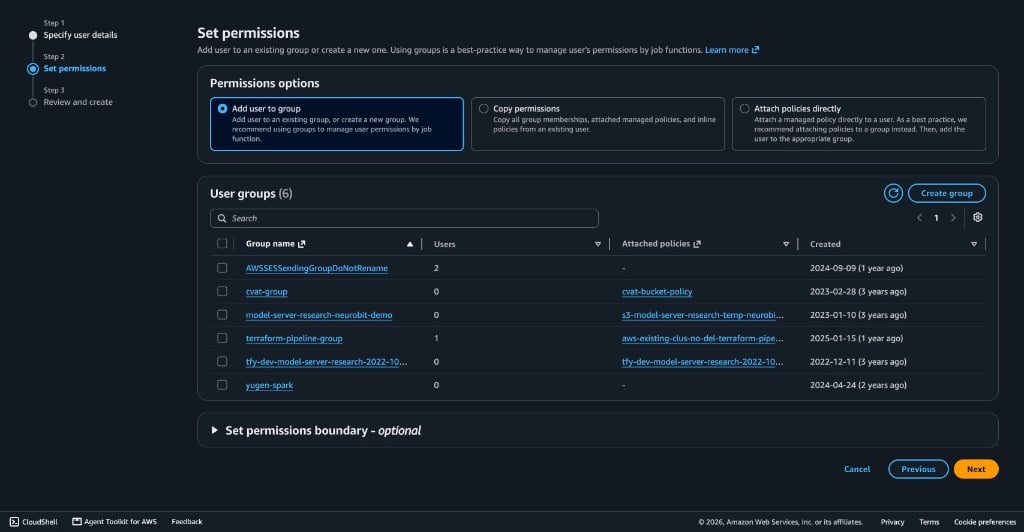 5. Finish **Create user**.
6. Open the new user → **Security credentials**.
7. Under **Access keys**, click **Create access key**.
8. Choose **Application running outside AWS** → **Next** → **Create access key**.
9. Copy **Access key** and **Secret access key** now. The secret is shown only once.
Do not paste raw keys into git, screenshots, or public docs. Prefer storing them in TrueFoundry Secrets and referencing them by FQN.
10. In TrueFoundry, open **Secrets** and create (or reuse) a secret group — for example `agentcore-aws`.
11. Add two secrets:
* Key: `AWS_ACCESS_KEY_ID` → value: your IAM access key ID
* Key: `AWS_SECRET_ACCESS_KEY` → value: your IAM secret access key
See [Manage secrets](/docs/manage-secrets) for the full UI flow.
12. Note each secret’s FQN:
```text theme={"dark"}
tfy-secret://::
```
Example:
```text theme={"dark"}
tfy-secret://truefoundry:agentcore-aws:AWS_ACCESS_KEY_ID
tfy-secret://truefoundry:agentcore-aws:AWS_SECRET_ACCESS_KEY
```
1. Go to **MCP Gateway** → **Add Server** → **Connect any Remote MCP Server**.
2. Set **URL** to the encoded AgentCore MCP URL from earlier.
3. Add **Collaborators** as needed.
4. Under **Auth Data**, select **AWS SigV4**.
5. Set **AWS Region** to the same region as the runtime (for example `us-east-1`).
6. Set **Credential Type** to the option you configured above and fill in:
5. Finish **Create user**.
6. Open the new user → **Security credentials**.
7. Under **Access keys**, click **Create access key**.
8. Choose **Application running outside AWS** → **Next** → **Create access key**.
9. Copy **Access key** and **Secret access key** now. The secret is shown only once.
Do not paste raw keys into git, screenshots, or public docs. Prefer storing them in TrueFoundry Secrets and referencing them by FQN.
10. In TrueFoundry, open **Secrets** and create (or reuse) a secret group — for example `agentcore-aws`.
11. Add two secrets:
* Key: `AWS_ACCESS_KEY_ID` → value: your IAM access key ID
* Key: `AWS_SECRET_ACCESS_KEY` → value: your IAM secret access key
See [Manage secrets](/docs/manage-secrets) for the full UI flow.
12. Note each secret’s FQN:
```text theme={"dark"}
tfy-secret://::
```
Example:
```text theme={"dark"}
tfy-secret://truefoundry:agentcore-aws:AWS_ACCESS_KEY_ID
tfy-secret://truefoundry:agentcore-aws:AWS_SECRET_ACCESS_KEY
```
1. Go to **MCP Gateway** → **Add Server** → **Connect any Remote MCP Server**.
2. Set **URL** to the encoded AgentCore MCP URL from earlier.
3. Add **Collaborators** as needed.
4. Under **Auth Data**, select **AWS SigV4**.
5. Set **AWS Region** to the same region as the runtime (for example `us-east-1`).
6. Set **Credential Type** to the option you configured above and fill in:
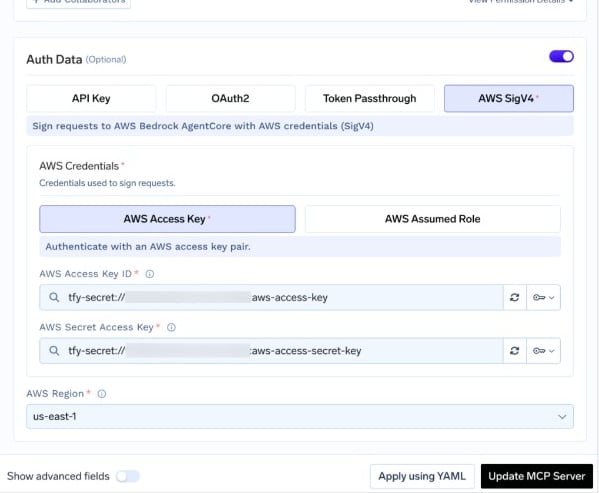 | Field | Value |
| ------------------------ | ----------------------------------------------------------------------- |
| **Credential Type** | **AWS Assumed Role** |
| **AWS Assumed Role ARN** | `arn:aws:iam::123456789012:role/AgentCoreRole` or a `tfy-secret://` FQN |
Do not enter access keys when assumed role is selected.
| Field | Value |
| ------------------------- | --------------------------------------------------------------------------- |
| **Credential Type** | **AWS Access Key** |
| **AWS Access Key ID** | `tfy-secret://…:AWS_ACCESS_KEY_ID` (or the raw key for a quick test) |
| **AWS Secret Access Key** | `tfy-secret://…:AWS_SECRET_ACCESS_KEY` (or the raw secret for a quick test) |
7. Click **Add MCP Server** (or **Update**).
```yaml AWS Access Key theme={"dark"}
type: mcp-server/remote
name: my-agentcore-mcp
url: https://bedrock-agentcore.us-east-1.amazonaws.com/runtimes/arn%3Aaws%3A.../invocations?qualifier=DEFAULT
auth_data:
type: aws-sigv4
region: us-east-1
auth:
type: aws-access-key
access_key_id: tfy-secret://truefoundry:agentcore-aws:AWS_ACCESS_KEY_ID
secret_access_key: tfy-secret://truefoundry:agentcore-aws:AWS_SECRET_ACCESS_KEY
```
```yaml AWS Assumed Role theme={"dark"}
type: mcp-server/remote
name: my-agentcore-mcp
url: https://bedrock-agentcore.us-east-1.amazonaws.com/runtimes/arn%3Aaws%3A.../invocations?qualifier=DEFAULT
auth_data:
type: aws-sigv4
region: us-east-1
auth:
type: aws-assumed-role
assumed_role_arn: arn:aws:iam::123456789012:role/AgentCoreRole
```
| Field | Value |
| ------------------------ | ----------------------------------------------------------------------- |
| **Credential Type** | **AWS Assumed Role** |
| **AWS Assumed Role ARN** | `arn:aws:iam::123456789012:role/AgentCoreRole` or a `tfy-secret://` FQN |
Do not enter access keys when assumed role is selected.
| Field | Value |
| ------------------------- | --------------------------------------------------------------------------- |
| **Credential Type** | **AWS Access Key** |
| **AWS Access Key ID** | `tfy-secret://…:AWS_ACCESS_KEY_ID` (or the raw key for a quick test) |
| **AWS Secret Access Key** | `tfy-secret://…:AWS_SECRET_ACCESS_KEY` (or the raw secret for a quick test) |
7. Click **Add MCP Server** (or **Update**).
```yaml AWS Access Key theme={"dark"}
type: mcp-server/remote
name: my-agentcore-mcp
url: https://bedrock-agentcore.us-east-1.amazonaws.com/runtimes/arn%3Aaws%3A.../invocations?qualifier=DEFAULT
auth_data:
type: aws-sigv4
region: us-east-1
auth:
type: aws-access-key
access_key_id: tfy-secret://truefoundry:agentcore-aws:AWS_ACCESS_KEY_ID
secret_access_key: tfy-secret://truefoundry:agentcore-aws:AWS_SECRET_ACCESS_KEY
```
```yaml AWS Assumed Role theme={"dark"}
type: mcp-server/remote
name: my-agentcore-mcp
url: https://bedrock-agentcore.us-east-1.amazonaws.com/runtimes/arn%3Aaws%3A.../invocations?qualifier=DEFAULT
auth_data:
type: aws-sigv4
region: us-east-1
auth:
type: aws-assumed-role
assumed_role_arn: arn:aws:iam::123456789012:role/AgentCoreRole
```